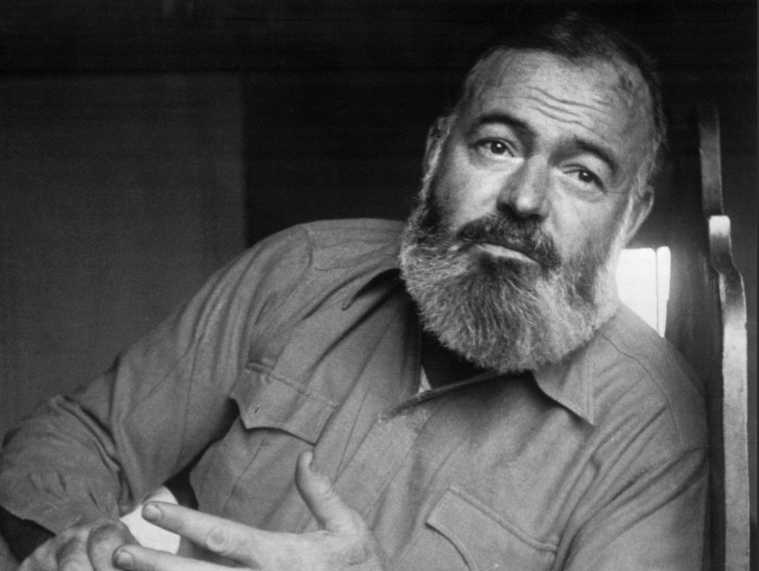
Age should never be a barrier to pursuing your dreams or trying something new.
Ernest Hemingway wrote “The Old Man and the Sea” in 1951, at the age of 52, during a period of personal and professional uncertainty. Hemingway had been struggling with writer’s block and had not published a novel in nearly a decade, which was a significant departure from his previous success as a writer.
The inspiration for the story came from Hemingway’s own experiences as a fisherman, particularly his time spent in Cuba where he had gone fishing with local fishermen. Additionally, he would run liquor from Havana, Cuba to Key West, Florida. Hemingway drew inspiration from a real-life incident that occurred in 1949, when a fisherman named Gregorio Fuentes caught a giant marlin that weighed over 1000 pounds.
Hemingway was also influenced by his own interest in the philosophy of existentialism, which emphasizes individual freedom and responsibility in a world that is often characterized by absurdity and meaninglessness. In “The Old Man and the Sea,” Hemingway explores these themes through the character of Santiago, who faces a seemingly impossible challenge but remains committed to his goal despite the odds.
The novel was well received upon its publication in 1952, and Hemingway was awarded the Pulitzer Prize for Fiction in 1953. “The Old Man and the Sea” is now considered a classic of American literature and is widely regarded as one of Hemingway’s most enduring works.

The novel’s brevity is noteworthy. In a world where many novels can exceed 100,000 words, Hemingway’s ability to convey powerful themes and emotions in just 26,000 words is a testament to his mastery of the written word.
“The Old Man and the Sea” by Ernest Hemingway:
I. Introduction
- The story begins with an introduction to the protagonist, Santiago, an old Cuban fisherman who has gone 84 days without catching a fish.
- Santiago is determined to catch a fish and sets out to sea in his small boat.
II. Part 1
- Santiago talks to himself and to the sea as he sails out to fish.
- He reflects on his past successes as a fisherman and his respect for the sea.
- Santiago catches a small fish, but he releases it because he believes it is bad luck.
III. Part 2
- Santiago hooks a large marlin and engages in a long and difficult struggle to catch it.
- He talks to himself and to the fish as he battles it, demonstrating his determination and skill as a fisherman.
- Santiago’s respect for the fish is evident throughout this part, as he recognizes the marlin as a worthy opponent.
IV. Part 3
- Santiago finally defeats the marlin, but he faces new challenges as he tries to bring the huge fish back to shore.
- The weight of the fish causes Santiago’s boat to be pulled backward by the wind and currents, and Santiago is forced to use all his strength and ingenuity to keep the fish and his boat moving in the right direction.
- Santiago reflects on the struggle and his own mortality.
V. Part 4
- Sharks attack Santiago’s boat and eat much of the marlin’s flesh, leaving only the skeleton.
- Santiago fights against the sharks, but he is unable to save his catch.
- Santiago returns to port, bruised and exhausted.
VI. Part 5
- Santiago carries his mast home as a symbol of his achievement, and the other fishermen at the port recognize his effort and skill.
- Santiago goes to bed and dreams of his youth and of lions on the beach in Africa.
- The story ends with Santiago’s determination to go back out to sea again, despite his age and the difficulties he has faced.
Through the character of Santiago, Hemingway explores themes such as aging, mortality, courage, and the relationship between humans and the natural world. The novel is also notable for its spare and understated writing style, which has become a hallmark of Hemingway’s work.
“The Old Man and the Sea” is important because it marked a return to critical and commercial success for Hemingway. After a period of declining popularity, the novel was well-received by critics and readers alike, and it won Hemingway the Pulitzer Prize and contributed to his later Nobel Prize in Literature. It is considered one of his finest works and a classic of American literature.
Hemingway isn’t an exception in rekindling fame after age 50.
There are many writers who have gained success later in life.
- Raymond Chandler: Chandler began writing detective fiction in his 40s, but it wasn’t until he was in his 50s that he achieved widespread success with novels like “The Big Sleep” and “Farewell, My Lovely.”
- Haruki Murakami: Murakami was already a successful writer in Japan when he published his first novel in English, “A Wild Sheep Chase,” at the age of 43. However, it wasn’t until he was in his 50s that he became an international literary sensation with books like “Kafka on the Shore” and “1Q84.”
- Frank McCourt: McCourt was a teacher for many years before he published his memoir, “Angela’s Ashes,” at the age of 66. The book won the Pulitzer Prize and became a bestseller.
- Mary Wesley: Wesley began writing novels in her 70s, after the death of her husband. Her first book, “Jumping the Queue,” was published when she was 71, and she went on to write 10 more novels before her death at the age of 90.
- Laura Ingalls Wilder: Wilder began writing the “Little House on the Prairie” books in her 60s, based on her experiences growing up on the American frontier. The books became beloved classics of children’s literature.

The stories of writers like Raymond Chandler, Haruki Murakami, Frank McCourt, Mary Wesley, and Laura Ingalls Wilder show that it’s never too late to pursue your passions and achieve success. These writers all found success later in life, some even after they had retired from other careers. It’s a reminder that age should never be a barrier to pursuing your dreams or trying something new. No matter how old you are, it’s never too late to start writing, painting, or pursuing any other creative endeavor. As Hemingway once said, “It’s good to have an end to journey toward; but it is the journey that matters, in the end.”
 Geo Fish